
Chinese crown orchid



Scientific: Eulophia graminea
Common: Chinese crown orchid, Chinese ground orchid, grass orchid, grass leaved orchid, bawang hantu, ground orchid, Eulophia ground orchid, beautiful crown orchid
Origin: Subtropical and tropical Old World, East, Southeast Asia, Pacific Islands (Chang et al., 2010; Pemberton et al., 2008a; Pemberton et al., 2014; Weakley et al., 2026).
Introduction History: Suspected to be an ornamental introduction to Florida and first reported naturalized in southern Florida in 2007 (Pemberton et al., 2008a) with rapid subsequent spread across peninsular Florida (Pemberton, 2013).
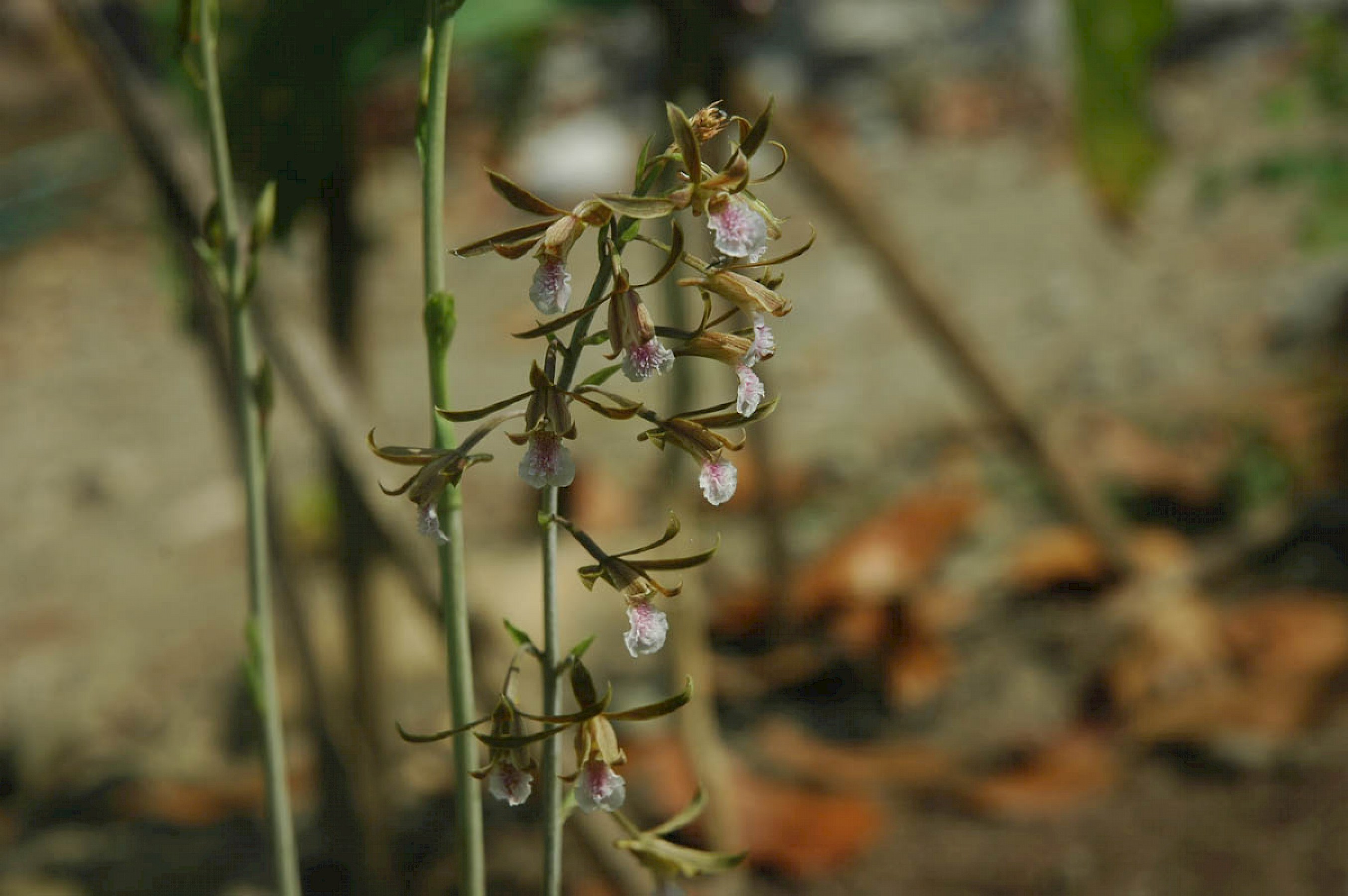
General Description: A terrestrial, perennial orchid that grows in disturbed sites, cultivated gardens, lawns, roadsides, and natural areas. Plants produce grass-like leaves from underground or partially exposed pseudobulbs and flowering stalks that may exceed 1 m in height. Numerous greenish to brownish flowers with purple markings on the upper part of flower.
Family: Orchidaceae (orchid family)
Habitat: Frequently transported in mulch, potting media, and landscaping materials. Found in cultivated areas (lawns, gardens, parks), disturbed areas (roadsides, construction sites), and various natural areas (margins of pine flatwoods, pine rocklands, upland microsites in cypress swamp (Chang et al., 2010; Pemberton, 2013; Weakley et al., 2026).
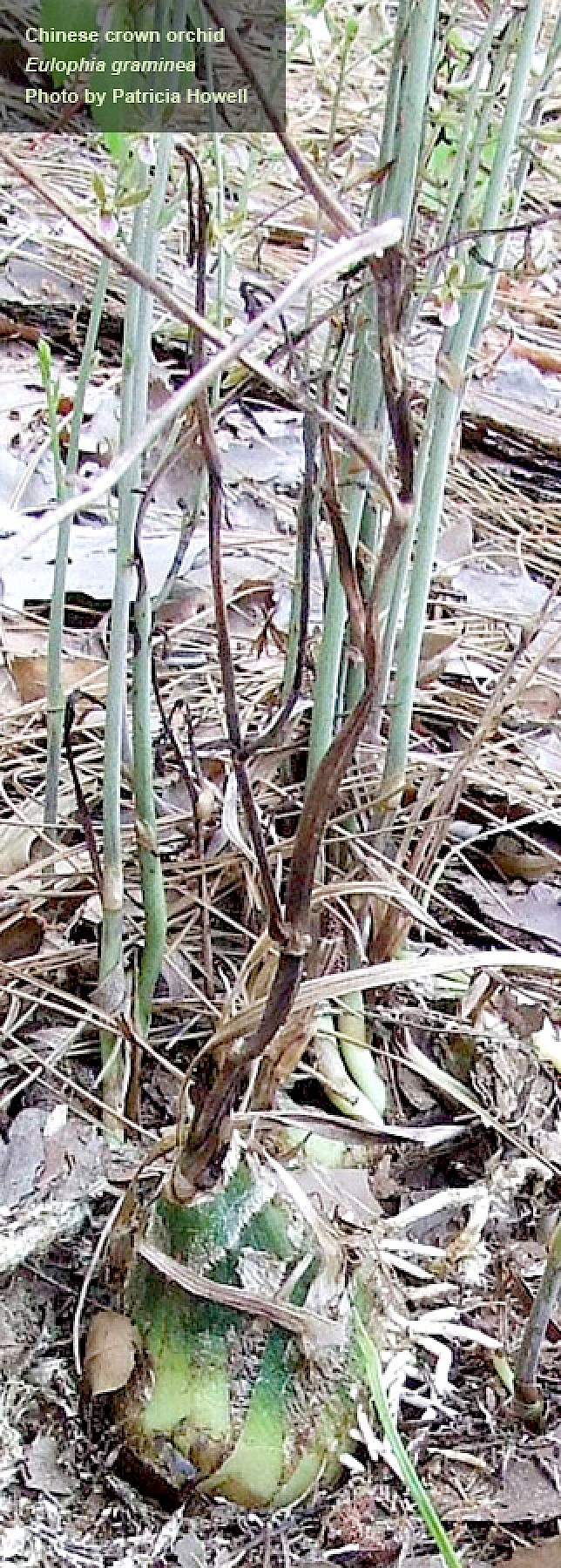
Leaves: Linear to lanceolate grass-like leaves (Ang et al., 2011; Weakley et al., 2026). Strongly pleated at central vein (Comber, 2001). Measuring 1-15 inches long (Weakley et al., 2026).
Pseudobulbs: Pale white to green color. Spherical to conical in shape, 2-3 inches wide. Can be found underground, partially exposed, or completely above soil surface (Pemberton et al., 2014). Promote local, asexual colony production and vegetative persistence (Chang et al., 2010).
Inflorescence: Thin, erect, racemose spike arising from pseudobulb typically measuring 15-30 inches tall (Weakley et al., 2026) but can grow nearly 5 feet tall (Pemberton et al., 2014).
Flowers: Inconspicuous greenish, tan, or purple hued flowers with pale lip sometimes with pink middle. Up to 60 flowers per inflorescence (Pemberton et al., 2014), maturing sequentially along spike. Flowering in October-January (North American Orchid Conservation Center, 2020; Weakley et al., 2026).
Fruit: Brown to green hued capsule measuring up to 1 inch long (North American Orchid Conservation Center, 2020). Reportedly low rates of fruit production (Pemberton et al., 2014). Self-compatible but demonstrates greater probability of fruit production when outcrossed. Requires insect pollination (Chang et al., 2010; Pemberton et al., 2008a; Williamson, 1984).
Seeds: Tiny, wind-dispersed, dust-like seeds have allowed for rapid expansion of this orchid’s range in the Caribbean (Ackerman & González-Orellana, 2021). Germination, like other orchids, may depend upon a fungal interaction but may include a broader diversity of fungus species compared to native orchids (Downing et al., 2020; Pemberton et al., 2014). Seeds develop into pseudobulbs (Chang et al., 2010).
Invaded Range: Reported naturalized in Australia (Macrae, 2002), South Africa (O’Conner et al., 2006), Caribbean (Ackerman & González-Orellana, 2021), Mexico (Juárez Gutiérrez et al., 2023), and Florida (Pemberton et al., 2008a). One report from Texas (Botanical Research Institute of Texas, 2026; Singhurst et al., 2020). Likely not fully expanded and may benefit from future climate conditions (Chang et al., 2010; Kolanowska et al., 2024). In Florida, most abundant in the southern peninsula (EDDMapS, 2026).
Regulation/Categorization: FISC Category “II”, UF/IFAS Assessment “Caution”
Ensure landscaping materials are from reputable sources to minimize contamination risk. Report to responsible manager if found in natural areas. Do not purchase or plant this species, seek native alternative ground orchids. Read more here.
Hand removal, best done before it flowers and develops seeds pods.
For small-scale infestations, hand pulling is achievable for most Florida soil types (Brown et al., 2012). Ensure to remove all pseudobulbs present and bag viable seed capsules if present (Mitchell, 2013). Dispose of all plant material responsibly to prevent further spread.
No currently implemented biocontrol agents.
No species-specific herbicide evaluations have been published. Chemical control of morphologically similar plants (with belowground storage organs) is often difficult.
UF IFAS Assessment of Non-Native Plants in Florida's Natural Areas
An Exotic Orchid, Eulophia graminea, Invades Charlotte County

